

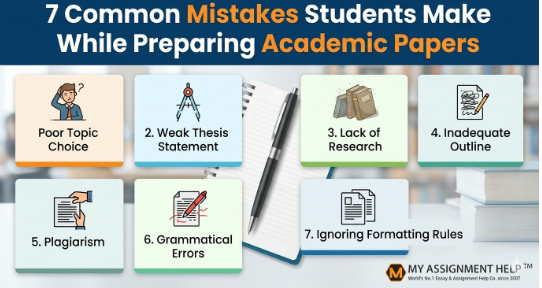
Paste or import yThe transition from high school writing to college-level academic research is notoriously difficult. Undergraduate and graduate courses demand a rigorous approach to data synthesis, critical thinking, and structural clarity. Yet, many students rely on outdated study habits that fail to satisfy complex evaluation rubrics.
According to institutional research from groups like the EAB (formerly the Education Advisory Board), a significant portion of first-year college dropouts or course failures stem from academic underpreparedness, particularly in writing and research. When the structural complexity of a major essay increases, relying on last-minute inspiration leads to predictable failure.
To help navigate these hurdles, using a trusted college term paper writing service can provide invaluable guidance, offering structured models and expert editorial feedback to refine your work. This comprehensive guide breaks down the seven most common pitfalls students encounter during the research paper writing process and provides actionable, data-backed strategies to avoid them.
The Core Stages of Academic Research
Before diving into specific pitfalls, it helps to visualize the ideal research lifecycle. True academic writing is an iterative, cyclical process, rather than a linear sprint. The diagram below illustrates how professional researchers balance exploration, drafting, and systematic refinement.
1. Misunderstanding or Narrowing the Thesis Statement
A thesis statement is the intellectual anchor of your entire paper. A common misstep is writing a thesis that is purely descriptive rather than argumentative.
A descriptive thesis simply states a widely accepted fact (e.g., “Climate change impacts global agricultural yields”). An argumentative thesis presents a nuanced claim that requires defense using empirical data (e.g., “While modern agricultural innovations mitigate topsoil degradation, shifting precipitation patterns in the American Midwest will reduce corn yields by fifteen percent over the next two decades unless sustainable irrigation policies are mandated”).
According to writing center data from major institutions like Harvard and UNC Chapel Hill, over forty percent of early-stage draft revisions focus primarily on refining an overly broad or weak central claim. If your thesis is too broad, your paper will read like a generalized summary rather than an analytical synthesis.
2. Inadequate or Superficial Literature Review
A high-quality academic paper must engage deeply with existing peer-reviewed literature. A frequent error is selecting the first handful of abstracts that appear on Google Scholar without verifying the study design, citation count, or methodology.
Metric
Weak Literature Review
Rigorous Literature Review
Source Variety
Relies entirely on websites, blogs, or single textbooks.
Utilizes peer-reviewed journal articles, metadata analyses, and institutional reports.
Critical Evaluation
Accepts all source findings at face value without questioning bias.
Compares conflicting methodologies and highlights gaps in existing research.
Synthesis Style
Paragraphs read like an isolated list of summaries (“Author A said X, Author B said Y”).
Integrates sources thematically to build a logical narrative arc.
Relying on a superficial review creates a weak foundation for your arguments. To save time when balancing heavy course loads, many students look for reliable academic support and decide to do my homework through professional services, which helps ensure their papers feature thoroughly researched, high-authority literature bases.
3. Flawed Data Presentation and Poor Evidence Integration
Data must be carefully synthesized into your narrative, not simply dropped into a paragraph without context. A major mistake is presenting a quote or a statistical data point as a standalone sentence without surrounding analysis.
A standard standard framework for proper evidence integration is the “ICE” method:
-
Introduce: Give context to the data point or quotation (e.g., “In a longitudinal study tracking 1,200 participants, Dr. Smith discovered…”).
-
Cite: Provide the exact data point or direct quotation alongside the required citation format.
-
Explain: Explicitly connect the evidence back to your primary thesis statement. Explain why this data matters.
Additionally, when using tables or visual figures, students often fail to refer to them directly in the text. Every chart must be accompanied by analytical commentary that explains how the visual data supports the central thesis.
4. Academic Integrity Violations and Poor Citation Management
Plagiarism is rarely an intentional act of academic dishonesty; more often, it is the result of disorganized research habits. According to data gathered by the International Center for Academic Integrity (ICAI), poor time management and a lack of understanding regarding citation rules account for a significant percentage of academic integrity violations.
Common administrative citation errors include:
-
The “Mosaic” Citation Trap: Patching together sentences from different sources, changing a few words, and failing to use quotation marks or a clear citation.
-
Missing In-Text Citations for Paraphrases: Believing that an in-text citation is only required for direct, verbatim quotes. Unique ideas and data points always require attribution, even when rephrased in your own words.
-
Secondary Source Misattribution: Citing a primary source that you read about in a secondary text without actually reading the original work yourself.
Using modern reference management tools like Zotero, Mendeley, or EndNote can drastically reduce these technical errors by systematically organizing your bibliography from day one.
5. Structural Disorganization and Fragmented Paragraph Transitions
An academic paper should flow logically from one point to the next. A common issue is a lack of structural unity, where paragraphs read like a collection of disjointed thoughts rather than a cohesive argument.
To ensure your paper maintains a clear narrative flow, use the MEAL plan structure for your body paragraphs:
-
Main Idea: Begin with a clear topic sentence that outlines the paragraph’s core claim.
-
Evidence: Present the supporting data, statistics, or expert testimonies.
-
Analysis: Deconstruct the evidence, showing how it supports your topic sentence.
-
Link: Provide a transitional sentence that connects this concept directly to the upcoming section.
Without these explicit structural connections, your reader is forced to guess how your different arguments relate to one another.
6. Over-reliance on AI Generation and Passive Writing Voices
The rise of generative AI tools has introduced a new challenge to academic writing: the proliferation of generic, unverified content. While AI tools can assist with early-stage brainstorming, relying on them to draft your paper can compromise academic rigor.
AI-generated text often suffers from specific flaws:
-
Factual Hallucinations: Inventing citations, page numbers, or historical events that do not exist.
-
Superficial Analysis: Relying on circular logic and repetitive phrasing rather than deep critical analysis.
-
Stylistic Flaws: Overusing passive sentence structures (e.g., “The experiment was conducted by the team”) which obscure the clarity of your writing.
Academic writing favors an active, precise voice. Direct, clear phrasing clarifies your methodology and ensures your arguments remain impactful.
7. Rushing the Proofreading and Revision Phase
Writing and editing are two entirely distinct cognitive processes. Trying to proofread your final draft immediately after writing it is highly inefficient, as your brain naturally fills in missing words and overlooks typos based on memory.
Professional writers recommend separating the creation phase from the editing phase by at least twenty-four to forty-eight hours. When reviewing your work, break your editing process down into three distinct passes:
-
The Global Revision Pass: Evaluate the structural integrity of the paper. Does the logical flow make sense? Is your thesis adequately supported by the evidence provided?
-
The Stylistic Pass: Focus on sentence structure, active voice, and removing unnecessary fluff or repetitive vocabulary.
-
The Technical Proofreading Pass: Check for mechanical errors, punctuation slips, and verify that every in-text citation matches your works cited page.
Key Takeaways
-
Refine Your Focus: Build your paper around a precise, argumentative thesis statement rather than a broad descriptive summary.
-
Evaluate Your Sources: Move past basic web searches. Prioritize peer-reviewed journal articles, metadata studies, and verified institutional databases.
-
Integrate Evidence Mindfully: Always introduce, cite, and analyze your data points. Never let a quotation stand alone without a clear connection to your thesis.
-
Organize Your Structure: Use structural frameworks like the MEAL plan to ensure your paragraphs maintain a logical flow and transition smoothly.
-
Dedicate Time to Editing: Separate your drafting and proofreading phases to catch subtle structural and grammatical issues before submitting your final paper.
Frequently Asked Questions (FAQ)
Q: What is the most effective way to fix a broad thesis statement?
A: To sharpen a broad thesis statement, introduce specific variables, a clear cause-and-effect relationship, or a defined context. Instead of stating “Exercise is beneficial for students,” refine it to focus on a clear outcome: “Regular aerobic exercise improves cognitive performance and reduces stress levels in undergraduate students by regulating cortisol production.”
How can I verify if an academic journal article is a high-quality source?
Look for indicators of authority like peer-review status, indexing in reputable databases (such as Scopus, PubMed, or Web of Science), clear methodologies, and a solid citation history. Be cautious of open-access journals that lack a transparent editorial board or explicit peer-review guidelines.
Q: What is the difference between a paraphrase and plagiarism?
A: A proper paraphrase completely restructures the original author’s idea using your own unique sentence patterns and vocabulary, and it always includes a proper citation. Plagiarism occurs when you keep the original sentence structure and merely swap out a few words with synonyms, even if you include an in-text citation at the end.
Q: How many sources should an undergraduate research paper typically include?
A: While assignment guidelines vary, a standard baseline for an undergraduate paper is roughly one to two peer-reviewed sources per page of text. For instance, an eight-page research paper will generally feature a bibliography of eight to sixteen high-quality sources.
References & Authority Sources
-
Harvard College Writing Center: Strategy and Frameworks for Integrated Essay Structures and Evidence Analytics.
-
The University of North Carolina at Chapel Hill (UNC) Writing Center: Thesis Construction and Global Editing Guidelines.
-
International Center for Academic Integrity (ICAI): Statistical Trends in Undergraduate Academic Performance and Research Planning (2024-2025 Reports).
-
EAB Institutional Research: Analyzing Academic Underpreparedness and Core Factors in Higher Education Retention Metrics.
Author Profile
Dr. Evelyn Vance
Senior Academic Content Strategist & Research Advisor at MyAssignmentHelp
Dr. Evelyn Vance holds a Ph.D. in Higher Education Administration from Boston University, specializing in curriculum design and academic literacy. With over twelve years of experience teaching undergraduate composition and advising students on advanced research methodologies, she develops comprehensive academic writing strategies that help students translate complex data into clear, high-impact research papers.
our content above to get started.
